
THE JOURNAL
ABOUT THE TOO-PERFECT THEORY, by Helder Guimarães
Published on May 27th, 2026
More than fifty years ago, an article was published in The Hierophant that stirred controversy inside the magic community: The Too-Perfect Theory. This piece written by Rick Johnsson is still today praised by ones and rejected by others, without very little dialogue between the believers of these viewpoints. Over the years, I have read articles and essays on this topic and have drawn my own conclusions that I am about to share. Let’s start as we should always: Where did it begin? According to Rick Johnsson own words:
“Recently, there was a great brouhaha on a national basis brought by a statement attributed to Dai Vernon, who was supposed to have said something to the effect that the spectator never or rarely was fooled by what a magician performed for him in the way of tricks.”
This event triggered Johnsson to share a “theory” (in my opinion, more an idea) that he had previously thought. There are two premisses that Rick Johnsson presents in order to formulate his idea. The first is the notion that the modern audience doesn’t attribute superpowers as a cause to what they have witness in a magic show. The second, as he words it, “to rational man, the unknown is unacceptable.” And this is the one I’d like to start focusing this analysis on. Before I do, I want to affirm that I deeply agree with the first premise. In the modern world, the audience knows there are secrets being kept from them. They might not know what those are, but they also knows there are no superior forces at work. This is, without any doubt, a shift from older times when lack of information allowed people to believe in irrational explanations. The second premisse, however, feels half-baked in my own opinion. But before addressing it, let’s read the explanation the author gives us:
“From the time of the early cave man, as curious as he was hairy, man has waged a never-ending battle, searching for reasons behind mysteries which surround him.”
I couldn’t agree more. It is impossible to have an audience in front of you and not have them engage in a mental process to find answers for what they are witnessing. It’s part of our fabric as human beings and, although I don’t think I can predict the future, it will exist until the dawn of civilization as we know it. “Think of the countless numbers of scientists and philosophers who have devoted their entire lives in search of the key to riddles which besiege man at every turn,” as he continues to make his point.
However, after some more cohesive examples of how this willingness to know was manifested over time, Johnsson lists three hypothesis for this curiosity:
“1) Man will find or invent an answer for that which baffles him.
2) That answer need not to be completely rational and / or consistent with available data.
3) Man is flexible in changing his answers in the light of more complete or acceptable data.”
This is the moment when I believe the second premisse he lays initial start to crumble. First of all, these three hypothesis are all addressed in the first one: “Man will find or invent an answer for that which baffles him.” Johnsson wants to shows us the willingness of a spectator to find answers is very high, and I don’t disagree with him at all. That said, this is not the only way we as a species deal with unknown, his second premisse. Think for a moment about how many thinks you interact daily that you don’t fully know. Why is the sky blue? There is a reason, but I don’t know. And not knowing doesn’t bother me. So why is it different in a magic performance? Because, unfortunately, a magic performance is many compose of one one-layer. When deception is displayed in center stage, the audience has very little else to interact with. Taking for granted they know you are the responsible for the impossible feats by secret means, the only way to fully engage with what they witness is to find possible solutions for what they are seeing. This one-layered approach leads, in the majority of cases, to the “three” hyphotesis that Rick Johnsson presents.
There is an essential element we are not addressing and that the author never mentions directly in his article either: the suspense of disbelief. Without it, a piece of Magic is never complete or perfect. But, in the middle of all these concepts, he correctly points out something about hypothesis number three that can be seen as a hint to this:
“However, if we now introduce Hypothesis 3 we can easily see that the spectator is open to suggestions for his solution...”
It’s actually bigger than this: spectators are open for us to guide they thru an experience. The amount of layers we give him will impact how we handles the deception part of our interaction. he proposes”
“... it would be wise for us to provide him with a possible solution of our own choosing, and which would accomplish the following:
1) Lead him away from the correct solution;
2) Be acceptable to him;
3) Not detract from the effect of the trick;
4) Give the magician full credit for his skill?”
By providing an acceptable false solution, what are we gaining? If the audience fully believes in a lie as a explanation for what they saw, the feeling of Magic is gone. At that point, why not just reveal the truth? It feels a lot of different conflicting ideas are being pushed together for the sake of arguing the audience always needs to find an answer, even if that answer is fake as long as it is satisfactory. Why is it not possible to have satisfaction as part of the experience we create, instead of finding this pleasure in an answer (being it true or false) to the witnessed impossibility? To believe the magic experience can be reduced to a simple puzzle lacks a clear understanding of its essence as a performing art. Eventually, Johnsson funnels all of these ideas to make his point:
“Correct or incorrect, the result is the same (...) In either case, the effect, therefore the entertainment value, is lost for the most part. It is then safe to postulate the tenets of The Too-Perfect Theory:
Some tricks, by virtue of their perfection, become imperfect.
Conversely,
Some tricks, by virtue of their imperfection, become perfect.”
The safety net of this postulation relies on the word “some.” Generalizations like these are often done in a light way because almost any rule accepts an exception. But instead of focusing on this, let’s try to understand what the author means by perfect and imperfect, two concepts sufficiently subjective. The first practical example is given even before these postulations, written as the spectator’s thought process:
“Let me see now... that sly old devil gave me the deck of cards, had me taken them into the next room, shuffle them select any one I wanted to, put the card back into the deck, put the deck in my pocket, and then come back into the room where he was. Then, without asking me any questions or even touching the deck, he told me what card I took!”
There is no doubt the effect, if remembered like this, would be impressive. He follows, in the same matter, with a possible solution:
“Wonder how he did that? Probably a stacked deck... but wait, it couldn’t be... I shuffled the deck. It’s probably some clever sleight-of-hand, but that couldn’t be either, ‘cause he never touched the deck. Hmmm... could it be a trick deck, because it was his deck... wonder what kind it could be? Eureka! A deck where all the cards are the same! I thought he went south with that deck awfully quick. That has to be it. Aren’t I clever?”
Let’s pause here to analyze a possible problem with this train of thought. Besides the amusing fact that a spectator would “think” of a stacked deck, or that you let a spectator take a deck composed all of the same card into another room without supervision, Johnsson is proposing that, under these impossible conditions, guessing a correctly a selected playing card is perfect if we use a force deck. I believe the relationship between the method used and the effect purposed always has a subjective degree, but the example given feels a terrible one when trying to make the case of a perfect trick. I do think the effect purposed might be a perfect one, but the method is far from it, in my own opinion.
The author then engages in a series of different path to try to solve the problem he identifies as a too-perfect. But, “Before commencing, it might be worth mentioning, for sake of completeness, that there is another technique - that of eliminating all possible solutions.” Not wanting to take that path as he clear sates, he proceeds with a series of imperfections we could add to above described piece. And again, in my opinion, he misses the point as he is adds details to make the above method actually better, or, as it is appropriate to say in this particular case, more perfect. For example, adding two two indifferent cards to the force deck help sell the idea of the whole deck being different, covering the methodology from a psychological point of view. Another suggestion given is to receive grab the deck, place it in the pocket, retrieving to cards that would give the value and suit of the selection and, in the process, switch the deck. Although changing the way the card is reveal might weaken slightly the effect, the overall result is much better and more perfect, in my opinion.
As always, we need to adapt the structure of the effect to the method we can accomplish. We don’t really have powers and our limitations forces us into that approach. When talking with Gabi Pareras about this theory, he mentioned as an analogy the Icarus myth as the reason why certain effects that aim to be perfect fail. Icarus, in the Greek mythology, was son of the inventor Daedalus who perished by flying too near the Sun with waxen wings. The problem was not the sun (the effect), neither the wings (the method), but Icarus himself who didn’t listen to Daedalus’ advice. Using this wise advice from Gabi, one might assume there are only two paths to resolve this problem: either one changes the effect, or one changes the method. But there are in fact three options, with the third one being a compromise of effect/method. How would this apply to the method / effect we have been discussing?
My first suggestion would be to not leave the room. I know in theory that makes it stronger, but I feel there are equally strong solutions. And, if we want to address it, the audience might think there is a secret camera on the other room and the performer can secretly access the footage. Going to a different room doesn’t necessarily blocks possible solutions a creative audience member might present. What if the cards are handled below the table? This makes it clear to the audience, who now witnesses the full process, that you can’t peek or see anything. So, briefly, with some more details, here is a possible perfect method for the effect purposed. A force deck with two indifferent cards, one short in the middle and one regular on the bottom. The deck is held in your left hand, face down. Reach with your right hand in the middle, grabbing the short card and removing. Explain this is what you want the spectator to do, reach somewhere in the middle and remove a card at random. Flash the identity of this card and the one at the bottom of the deck. Place the card back at the face of the deck and hand it to the spectator, asking him to do this under the table. Look away, so the spectator can peek the card he removed and put it back somewhere in the middle of the deck. And shuffle it, all under the table. He then is asked to take the box under the table and place the full deck inside the box. Now, in these extreme conditions, you ask the spectator to place the deck in his pocket. You conclude by reading their mind, adding suspense of disbelief into the mix. Being too direct will point towards the method, but the right theatrics with the details just mention with make this a perfect moment of Magic. But you are not done, because you still need to take the deck away from him. And we will use it to add an extra layer.
Once the revelation is made, naturally the participant will reach back in his pocket to take the deck. As soon as he takes it, we can enter in recapping mode: “And remember, I never saw the deck. It is inside the box in your pocket!” Pick the deck from him to show around to everyone. “And you selected the card below the table. I can’t see thru things!” Place the deck under the table and use this opportunity to switch it for a stacked memorized deck. Continue: “I know you will wonder about this for a while. So, I want to add one extra moment to this memory we are creating.” You executed the most bold deck switch there is, but no one will suspect it because they thought you were done. Now, you are refocusing their attention. “Remember you shuffled the cards, you took any card you wanted from any place and the you placed it back somewhere in the middle and you placed everything inside the card box: Look at the box: is it possible to see anything that is inside?” This reaffirms not only that this is the deck they handled, but how impossible what they are about to see is. On top of all of this, you can have a visible mark done in both card cases so they look identical but, in the audience perspective, unique. Once the spectators confirm it’s impossible to see inside the cardcase, tell they you will reveal exactly the position of the card they selected. They will doubt you, but you then proceed to do it. This will not only nicely complement the first very fair revelation while simultaneously completely cancelling all reasonable possibilities for the original effect. This more perfect routine to a similar perfect effect is my argument that it’s not a all or nothing situation. Every case is a unique one and generalizations might not help find the best solution to each particular situation.
I went over this practical example a presented my thoughts on it to demonstrate what I believe the Too-Perfect Theory really is: a soundbite. The reason why it started a discussion and became popular is because the formulation of the perfect / imperfect balance is catchy, easy to grasp and feels like an theory. That is not to say there are not valuable points we can extract from it, but I don’t believe it’s a fully cohesive system of thought or approach to what we do. I’ve mention some of the ideas I agree with the original article and I’ve expressed my arguments for the ones I don’t. But, as an extra layer, this article had been analyzed by many other peers in the magic community. A few years ago, Genii republished the original article and some of the most notorious contributions to this discussion on its August 2001 issue. I will not delve into all of them, as I feel the conversation might spread over too many different interpretations of the original article. Instead, I will focus on one single contribution given by Jon Racherbaumer, responsible for originally publishing the Too-Perfect Theory.
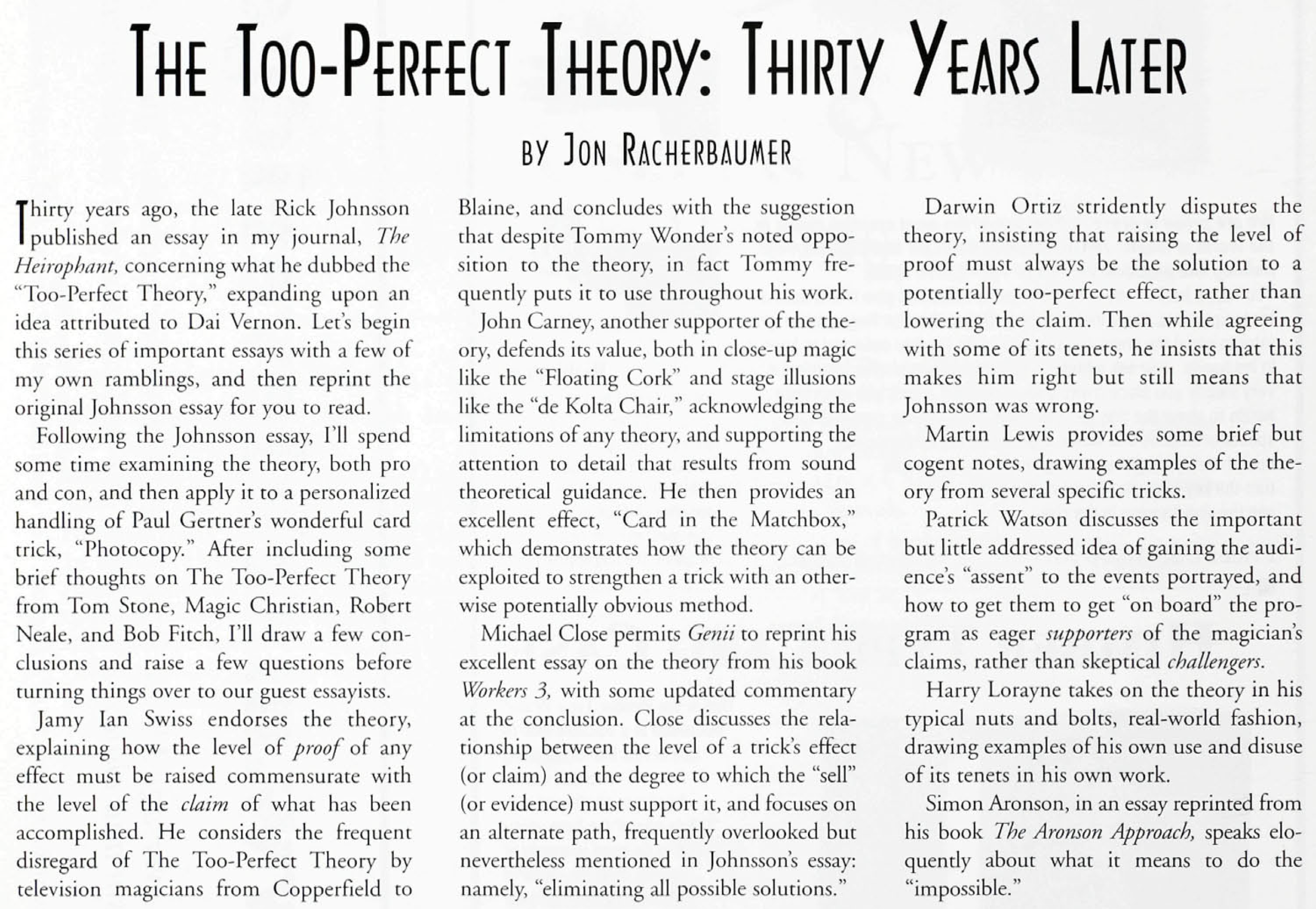
In Genii Magazine (August 2001)
After this introduction to all the view points that will be expressed in this collection, Racherbaumer proposes a way to put the theory in action using Paul Gertner’s Photocopy as a example (you can find it published in the book Steel and Silver). The effect makes a selected card vanish from the hand of the performer where it is palmed and appears inside a paper folded that was previously shown empty. Then, it is revealed that the card selected not only is inside the paper but is now printed in the paper. The use of a photocopy of an empty hand for storytelling makes this simply effect much more emotional, interesting and impactful. Racherbaumer believes the effect is too perfect. I don’t. What I do believe is that the original version lacks the conditions for the method to sustain the effect it is trying to covey. First, the method we are using to create this effect doesn’t disprove the method itself, leaving room for the audience to in fact associate the outcome with the idea of a duplicate. My first question is: How is this too-perfect? Honestly, I can’t understand this routine being considered too perfect without a signed card being used. Then, we could start making considerations about the claim itself. The relationship between effect and method is of vital importance in the creation of the magical atmosphere, but the audience will always question the singularity of the selection unless we emphasize how fair that same selection was.
So let’s go over the structure of the routine and try to make it perfect. In Photocopy, a Dribble Force is used and that is not enough to prove that the card they selected was que one appearing inside the folded paper. Without changing the method structure, and using the idea of a duplicate, I would say a torn corner would be sufficient to create the feeling that the card is the same. With that in mind, the printed card in the paper being the one with the torn corner takes the impossibility to a new level in my opinion. So now, the force element is less important because of this new added element that creates the desire singularity of the card. What is missing to make this effect even more perfect? The switch of the papers. In the original version, it is done with a Himber Wallet, and that is a possibility. But once the folded paper element of the routine is introduced, putting it back in the wallet makes no sense and destroys a bit the magical atmosphere. Why? Because the photocopy of the hand is the element, and that is taken again inside the wallet, I feel it becomes suspicious. What if, the paper is not the main thing but there is something inside the paper? You remove your wallet, take the folded piece of paper and let the audience unfold it to find inside an object: a old playing / a photo / a banknote / a newspaper clipping / etc. Something that relates to the presentation of the routine your are about to do. Then, it’s not longer about the paper but what it holds. This would create a perfect framework to then refold the paper and place it back in the wallet, leaving the wallet in full view on the table. There is a way of introducing objects in the context of a magic routine, so they are the protagonists when they need to be. The folded once of paper with an empty hand photocopy it’s an interesting object. But by introducing it early in the routine, you now have to make sure people disregard it a bit before making a switch. This can be accomplished by doing some other effect before with it and once that first effect is over, then create the right justification to place the folded piece of paper away and execute the secret switch. Another option would be to relegate the use of the paper to a secondary use (like having something inside) and having the effect of a card appearing inside the folded paper and the paper being printed be a surprise. This will help avoid the Icarus Effect as Gabi Pareras expressed to me.
I am not claiming these ideas will make this effect too-perfect, but they will help creating a true feeling of impossibility. If you have a great idea for an effect, but if the method doesn’t sustain the effect you are claiming, then you can’t claim that said effect. The rule is as simple as that. That is not a theory, or it has anything to do with being too-perfect: it’s us understanding how design a better magic experience for the audience. And if any conclusion should be have about the Too-Perfect Theory, is that, in my opinion, focus the magic conversation around the aspects that enhance the trickery side of magic and not the experiential side of magic performance. Without actually performing, these ideas might be interesting to discuss but will not lead any place fruitful. Only when performance plays a role on how we analyze these ideas, the conversation becomes real. My conclusion is: there is some truth about the claims Rick Johnsson makes, but the ideas and solutions presented to solve the issue are not how to solve these problems. The audience knows we are using secrets to accomplish the feats we show. They might believe more in false explanations and prefer to think these are real rather than accepting they don’t know how something was done. But the way to think of the experience of Magic should be different: as a metaphor to express ideas, like any other art form. This act of self-expression will bridge the methods we create and the effects we convey, inside the theater of illusions we operate. I honestly believe any impossibility can be too-perfect, if the audience understands you are trying to express something with your work.
To finalize, I would say that the beneficial part of the Too-Perfect Theory is not to disprove it or to agree with it but to contemplate our creations and understand what might be missing from them. Sometimes, the method that can be enhanced, or the experience must be changed. What we can’t do is think something is finished. There is always something to be seen, done, added and all of those happen when you keep thinking about your routines and creations. As a soundbite, the Too-Perfect Theory is perfect for us to keep arguing about all of these things. Maybe even a little too-perfect for it.
In Genii Magazine (January 2002)