
THE JOURNAL
STORYTELLING - THE SHAPING OF EXPERIENCE, by Helder Guimarães
Published on July 1st, 2026
When people speak about storytelling, they often begin in the wrong place. They begin with plot, or with character, or with structure, or with some phrase that sounds comfortably instructional, like “how to keep an audience engaged.” I understand why. Those are useful entry points. They are practical. They promise immediate application. But, in my opinion, they begin a little bit too late.
For me, the first question is more fundamental: What is a story? Not what the ingredients of a story are, and not how you build or improve one. But what is it, really? The answer I have come to, after years of working not only with writing but especially with writing for magic, performance, staging, and live audience experience, is that a story is not the sequence of events we present. Events are everywhere. Life produces them constantly, without effort or meaning. Someone leaves. Someone waits. A letter is opened. A promise is broken. A child hears something not meant for them. A room becomes different because one person has entered it or because one person has left it. Events alone are not enough to build a story.
A story begins when events are arranged in such a way that they create an impact or change in the mind of another person. Because of this, I do not think of story as information, the same way I do not think of it as decoration either. A story is not a container for facts but the shaping of an experience, deliberately shaped to affect others. It is the organization of time, emotion, pressure, and perception so that another human being is able to travel through an experience they did not have, and yet feel it. That, to me, is the heart of the matter, and once one understands that, many other things begin to fall into place.
Because if a story is the shaping of experience, then plot is not merely what happens next. Storytelling is not a collection of separate techniques. It is a way of thinking about how experience is built. This is one of the reasons I have always felt that magic can teach us something unusually deep about storytelling. Not because magic is the same as storytelling in a loose metaphorical sense, but because magic makes visible certain truths about experience that other arts sometimes conceal. A routine, for instance, is not yet magic, just as a sequence of events is not yet a story, and a sequence of methods is not yet a magical experience. Something has to be organized in the spectator’s mind. Something has to be shaped in time. Something has to happen not only on the table or in the hands of the performer, but also inside the person watching.
This is where I find so much confusion in magic as an art form. The conversation often turns too quickly toward method, toward fooling, toward proof, toward the hidden action. These things matter, and they matter enormously in creating the desired mystery. But they are not the whole. In fact, they are often just the beginning. But if we want to dig even deeper, I would argue the method is not even the starting point. The true beginning is the spectator. For me, this point is not only relevant to magic. It is one of the deepest keys to storytelling there is. Because every serious story, whether written, spoken, staged, or performed as magic, is finally concerned with what is made to happen in another person.
That is why I care so much about the distinction between routine and Magic. A piece can impress, can astonish, or simply confuse. In the same way, it can even overwhelm. But Magic begins only when the spectator experiences something larger than the performer’s cleverness. Magic begins when the experience seems to exceed the mechanism. When, for a moment, what is being witnessed feels not like a puzzle presented skillfully, but like reality itself has shifted. This distinction matters outside magic too. It matters in literature, in theater, in cinema, in oral storytelling, in any art that moves through time. All such arts risk becoming procedural. They risk becoming only the display of construction. And construction, however intelligent, is not the same thing as experience.
One of the most difficult lessons in performing art is that hidden structure and lived experience are not one and the same. A writer may know exactly how the plot works and still fail to create a living story. A magician may know exactly how the method works and still fail to create Magic. A director may know exactly where every actor should stand and still fail to create a scene that breathes. A performer may know every beat of a piece and still fail to move the room. Why? Because performing art does not live in hidden design alone. It lives in the transfer of experience to the audience.
This is where I think many people misunderstand structure. They think structure is opposed to mystery, or that formal thinking somehow kills the life of a performance. I believe almost the opposite. Structure, when properly understood, is not the enemy of mystery but the reason a mystery survives. Without structure, experience disperses, attention wanders, and the deepest moments often arrive without enough preparation to be felt fully. Sometimes, they vanish before they have had time to take root. In essence, structure is not there to imprison wonder but to protect it. And that protection must be intelligent. It must not be mechanical, as a story is not a formula, just as a magical routine is not a secret disguised by a script. In both cases, the question is not merely whether the mechanism functions. Our goal should be to create a path built in such a way that the audience can truly experience it.
This is why, as years go by, I keep returning to the idea of The Magic Way, by Juan Tamariz. This concept of path seems to be the key to unlocking experiences. A story is a path. A performance is a path. A magical effect is a path. The audience does not simply arrive at the ending and judge it in isolation. They travel, gather assumptions, form expectations, and invest emotionally. They notice what is being emphasized and forget what we don’t focus on. They experience rhythm, delay, interruption, confusion, relief, suspicion, recognition, tenderness, dread, curiosity, and surprise. And the only reason the final event matters is because of the path that led to it.
The start of a journey might be perceived as the beginning of the performance, but so much work has already been accomplished before the first word is uttered. I truly believe the beginning of a magical effect is not a preamble before the secret work starts. It is already established by our common reality, as it defines the laws that will later be broken. Without this, Magic would lose its importance. And bringing this sense of reality to the performance can enhance the impossibilities we create. Because when we are presenting a magical moment, the middle is not the dead time between setup and climax. It is where possible explanations are allowed, redirected, weakened, or made irrelevant. That is part of what the audience will take with them, not only the final result. In the same way, the ending is not where the method concludes. Often, the method has already been completed before the reveal is made to the audience. The true ending of the experience is where the spectator’s remaining road leads him, and impossibility takes final shape in the mind.
That expression matters to me: final shape in the mind. Because art, in the end, is not what the artist does. It is what is shaped in another human being with it. This is one of the reasons I resist any understanding of storytelling that becomes purely technical. The point of technique is to produce a better experience. A cleaner one. A deeper one. A more honest one. A more lasting one. For that, understanding who you are is vital. When the character is fictional, one can decide many aspects about it. The writer knows where the person grew up, what school they attended, what wound they carry, what their habits are, what food they prefer, what trauma shaped them. None of this is useless. But none of it is enough. A character becomes “real” when pressure forces value into action. What does this person want? What are they afraid to know? What contradiction lives inside them? What will they protect even when it hurts them? What will they refuse even when it could save them? These are dramatic questions, but they are also profoundly human questions that allow character to become something more than fiction.
In Magic, this becomes even more important. The magician is never simply a person demonstrating secrets. The magician is the human form through which the impossible becomes legible. What kind of being appears to stand before the laws of nature and disturb them? Is this a playful being? A dangerous one? A tender one? A manipulative one? A witness? A poet? A liar? A guide?
The same effect performed by different people is not the same effect because the impossible is embodied differently, accepted by the performer as something unique that another performer can’t hold the same way. Which brings me to another point I find extremely important: embodiment is vital. We can address it technically and make it as polished as possible, but it is one of the ways meaning enters form. And this becomes especially clear once we move from silent reading into oral storytelling and, especially, live performance. Written language and spoken language are not the same thing. A sentence that works beautifully on the page may fall dead in the air. A paragraph that rewards rereading may confuse when heard once. A spoken story unfolds in one irrevocable duration. The audience cannot go back. That means a story written for the ear must think differently. It must think in breath, in recurrence, in audibility, in rhythmic clarity, in what can be retained in one take.
This is not a simplification of literature but a different kind of precision and clarity. I find this especially important because so much storytelling happens now in spoken form: live talks, personal narrative, performance, interviews, podcasts, stage work, lectures, intimate theater, magic, improvisation, spoken essays. And yet many people still prepare spoken language as if it were written prose being temporarily borrowed by a voice. It is not. The spoken line lives under different laws of communication. The listener must be carried. The body itself becomes part of syntax. And once the body enters, a new artistic layer becomes unavoidable for the oral storyteller or magician: delivery.
Delivery is often discussed lazily, as though it were personality, charisma, or ways of communicating with others. In my opinion, some people might have a natural way of achieving this that feels like a natural gift, but it might be insufficient for most people to rely on it. Technically, delivery is interpretation in time. It is the shaping of emphasis, pace, silence, and presence so that the story becomes fully itself in sound. The same words may become comic, brutal, tender, distant, intimate, exhausted, ironic, or grave depending on how they are carried. The pause is not dead air. It is shaped silence. Emphasis is not decoration. It is the redistribution of meaning. Pace is not speed. It is the regulation of attention. Stillness is not passivity. It can be one of the strongest forms of authority.
This too is something Magic understands, whether explicitly or not. A magical effect can become suspicious, elegant, impossible, comic, or trivial depending on rhythm, naturalness, and restraint. Over-delivery pushes attention back toward the performer. Under-delivery lets the atmosphere collapse into procedure. The strongest magical presence often comes from exactness: enough force to carry the room, enough quiet to let the impossible seem larger than one person. When this occurs, storytelling and magic become inseparable for me. Both ask the same profound question:
How do you shape belief without flattening mystery?
Not belief in the literal sense alone. I mean belief as a state of mental and emotional participation. This question becomes the deepest in performance. Because a story performed live is not merely a text delivered well. It is an event. And events are relational. This is something I care about very much. Performance is not only expression, but shared time. It is teller and listener in a room under conditions of mutual attention. The audience is not passive, and their silence is not neutral. Their stillness, laughter, confusion, breath, skepticism, generosity, and alertness all become part of the event of Magic. This is why a performed story changes from one room to another even when the words remain largely the same. The room changes the story because the listeners change the event. It is one of the deepest truths of performance, and Magic has always known this as well. A routine can be done in solitude, but Magic requires a witness. More precisely, it requires not only a witness but an active participant in experience. They supply the mind in which the impossible event will either die as puzzle or survive as magic. The more I think about this, the more I believe performance is not the delivery of a finished object. Performance is the completion of the object in shared time. And this changes the ethics of the work, too.
Once we understand that art is not merely made but received, responsibility changes. The question is no longer only “Is this clever?” or even “Is this beautiful?” It becomes “What am I asking another human being to undergo?” The direct implications of such a question are vast. What kind of pressure am I placing on them? What kind of vulnerability am I inviting? What kind of relation am I building? Am I guiding attention, or coercing it? Am I earning emotion, or extracting it? Am I opening experience, or merely displaying mastery?
These are not moralistic questions but artistic ones. The strongest work often feels generous not because it is soft, but because it respects the seriousness of reception. It understands that another person’s inner life is not a neutral storage space into which effects may be deposited. And this is why I think revision is one of the deepest artistic acts. Most people think of revision as correction. I think of it as seeing again. The draft is not yet the story. The draft is the place where the story begins to appear. Revision is where one asks what the material is actually trying to become. This is true in writing, and it is just as true in Magic. Revision in Magic should not begin from attachment to method. It should begin from the spectator’s path. Because once one stops reducing Magic to proof, and storytelling to sequence, one is forced to ask what larger horizon each work is serving. Not every story should aim at the same emotional destination. Not every magical effect should aim at the same kind of impossibility. Not every performance should serve the same idea of wonder. The important thing is not to force every work into one emotional ideology. The important thing is to understand what this work, in its deepest nature, is trying to make possible.
That is what I mean when I say storytelling is the shaping of experience. Experience is not generic. It has color, weather, scale, and consequence. It happens in the mind, but also in the body. It begins in the moment, but it often continues in afterthought. One of the great misunderstandings in art is the belief that the work ends when the event ends. Very often the opposite is true. The deepest work begins then. And perhaps this is why I care so much about fundamentals. Not because I believe in rigid rules. Not because I think art can be reduced to systems. But they help us ask better questions and find better answers. They help us distinguish movement from consequence, cleverness from mystery, sentiment from earned feeling, demonstration from experience, trick from Magic, event from story. They do not end the mystery of art; they help us approach it more honestly.
To me, that honesty begins with one simple reversal: not what did I make, but what happened in them. That is where story begins. That is where Magic begins. And that is where Art, in any serious sense, truly lives.
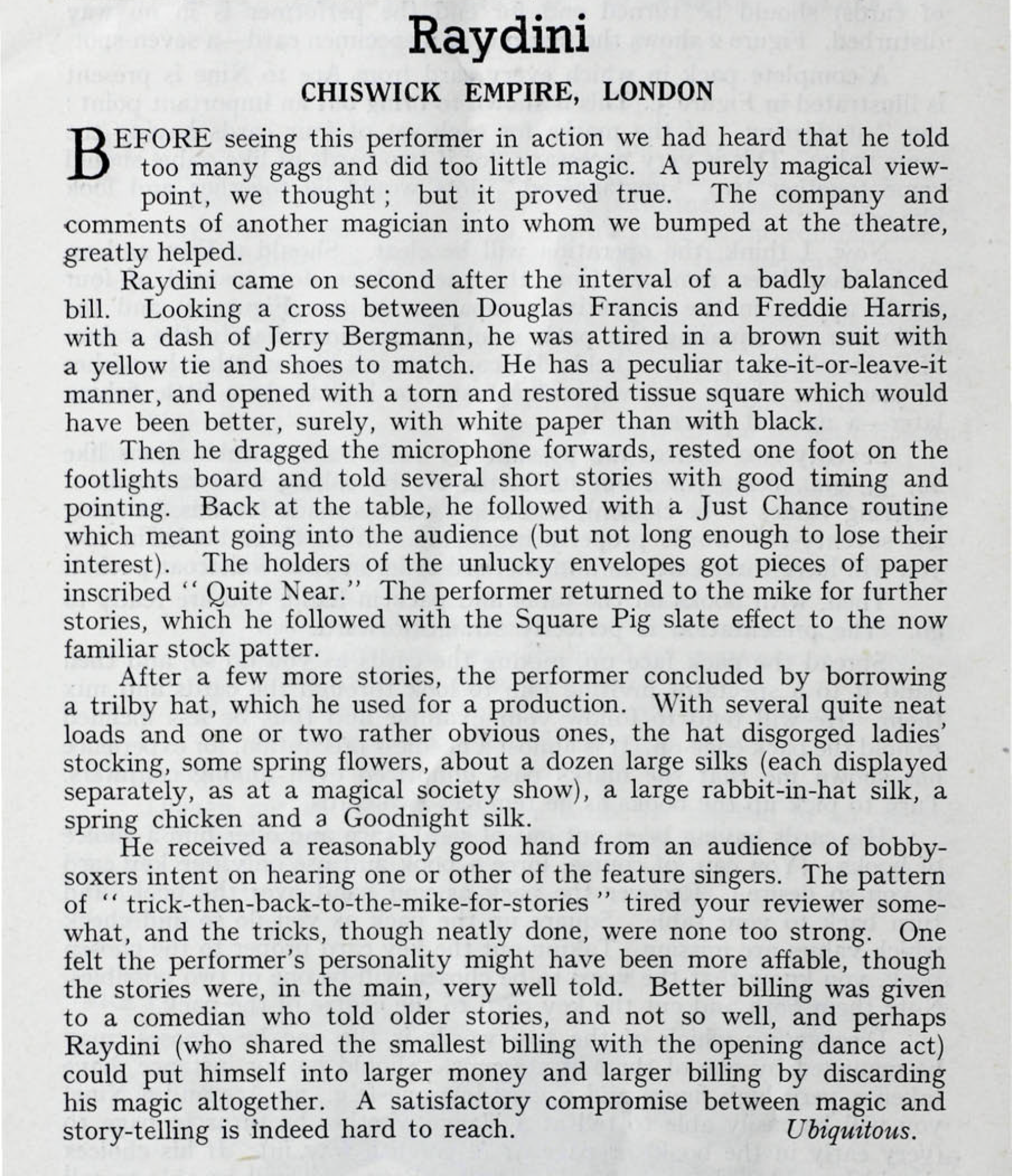
In Abracadabra, Vol. 10 No. 240